Industrial 3D animation is a core consideration for equipment enterprises in the visual promotion of their products. Its production cycle determines the speed and efficiency of publicity for new products and new equipment. Due to the significant differences in the structural complexity of machinery and equipment, the production cycle typically ranges from 2-8 weeks. The animation production cycle depends not only on its technical difficulty but is also closely related to the completeness of the client's material preparation and communication efficiency. Clarifying time allocation and collaboration points for each stage can effectively prevent delays in the cycle.
I. Client's Preliminary Material Preparation: The Foundation Determining the Production Cycle
The completeness of materials provided by equipment enterprises directly affects the efficiency of animation production startup. Four types of documents are core requirements:
1. Technical Data: Including equipment 3D models (e.g., STEP, IGS formats) or CAD drawings, and equipment color schemes (RAL color numbers or CMYK values or RGB values). Complete equipment models can accelerate the animation production progress and reduce dimensional errors during the modeling phase.
2. Video Script: The video script refers to the voiceover (some clients' videos do not require voiceover, and the script serves only as animation explanation or interpretation), which is the basis for the animation production script and an important reference for showcasing equipment highlights.
If it is an equipment operation and maintenance animation, a text version of the equipment operation manual or user manual must be provided.
Xuncheng Technology can provide script polishing and optimization services for clients, and based on this, evaluate video duration and production costs, allowing clients to understand in advance.
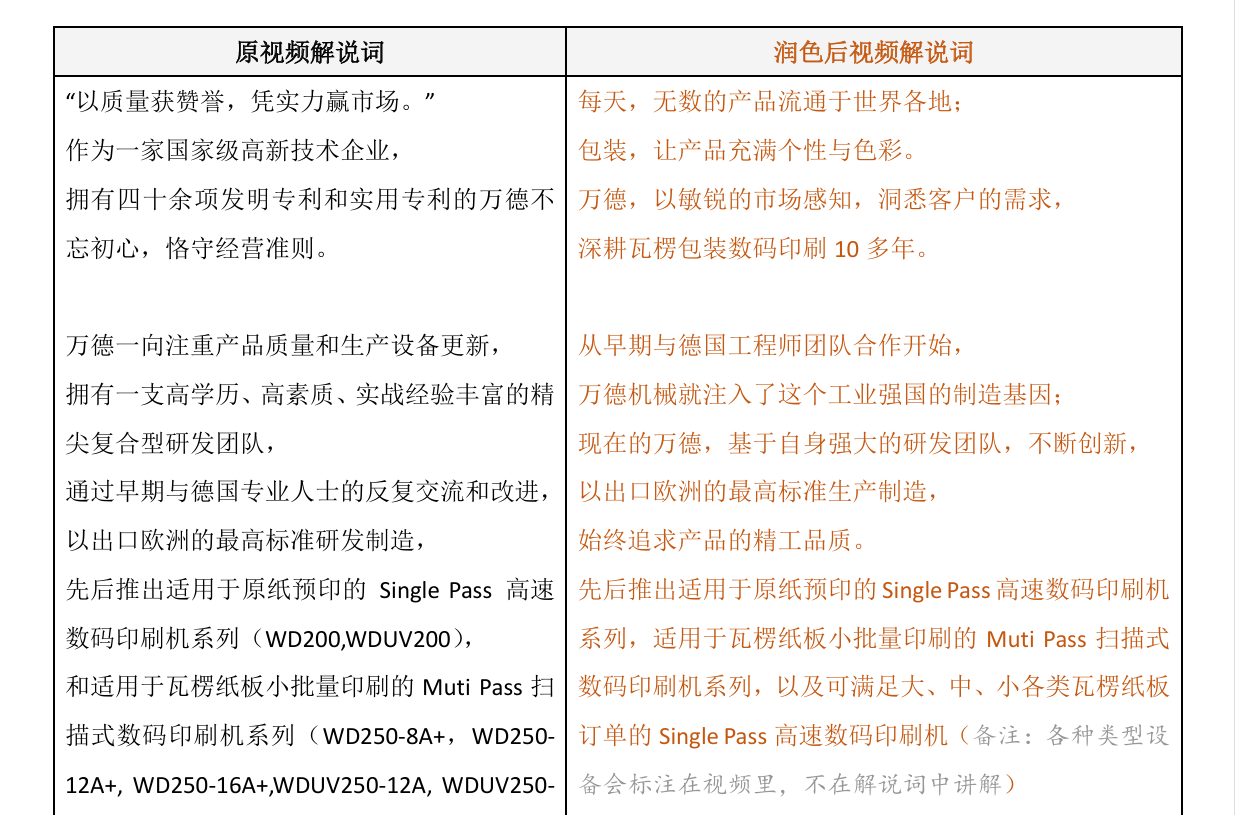
3. Reference Cases: Provide animation videos of competitor or benchmark companies, with shots showcasing important parts (can be simulated using Solidworks), which can help the production team quickly align visual expectations.
4. Company Information: Includes company LOGO, original files and typesetting formats for the company's full/abbreviated name in Chinese and English, and basic company information (address, official website, email, contact information, etc.). Some clients may also need to provide their exclusive opening or closing sequences.
In March 2025, Xuncheng Technology produced animation videos for two equipment factories with nearly identical products. Company A, a foreign-invested enterprise, had complete materials and submitted them quickly, delivering the animation video in 25 days. Company B, however, provided materials late and incompletely, taking 45 days for animation video production. The production cycles for animation videos of two almost identical pieces of equipment differed by 80%.
II. Core Animation Production Process: Close Collaboration is Key to Success
Although the animation production process is mainly carried out by the乙方 (Party B/production company), close collaboration between both parties significantly impacts the production progress. No matter how professional Party B is, they can never understand their products and equipment better than Party A (the client). Therefore, the production process involves communication issues, making timely responses and clarifications from Party A particularly crucial.
The animation production process is as follows:
Animation production can be divided into three main phases:
1. Modeling Period: 7-14 days
Includes modeling, texturing, scene setup, animation rigging, and rendering.
This period has the greatest impact on the overall animation production cycle. The influencing factors are mainly as follows:
① Timeliness of Party A's cooperation;
② Completeness of equipment models provided by Party A (inability of some clients to provide equipment models will lead to a longer modeling cycle);
③ Complexity of the equipment;
④ Whether related scenes are built (e.g., upstream and downstream equipment related to the production process of the equipment);
If complex scenes need to be produced (e.g., panoramic smart factories, cityscapes, complex airports, ports, docks, etc.), more modeling time will be required.
2. Post-production: 7-14 days
Includes importing into AE, voiceover, background music/sound effects, transition design, visual effects, fine-tuning, and animation output.
This period is primarily an internal production process for the animation company, but the level of detail required for various aspects significantly affects the production progress.
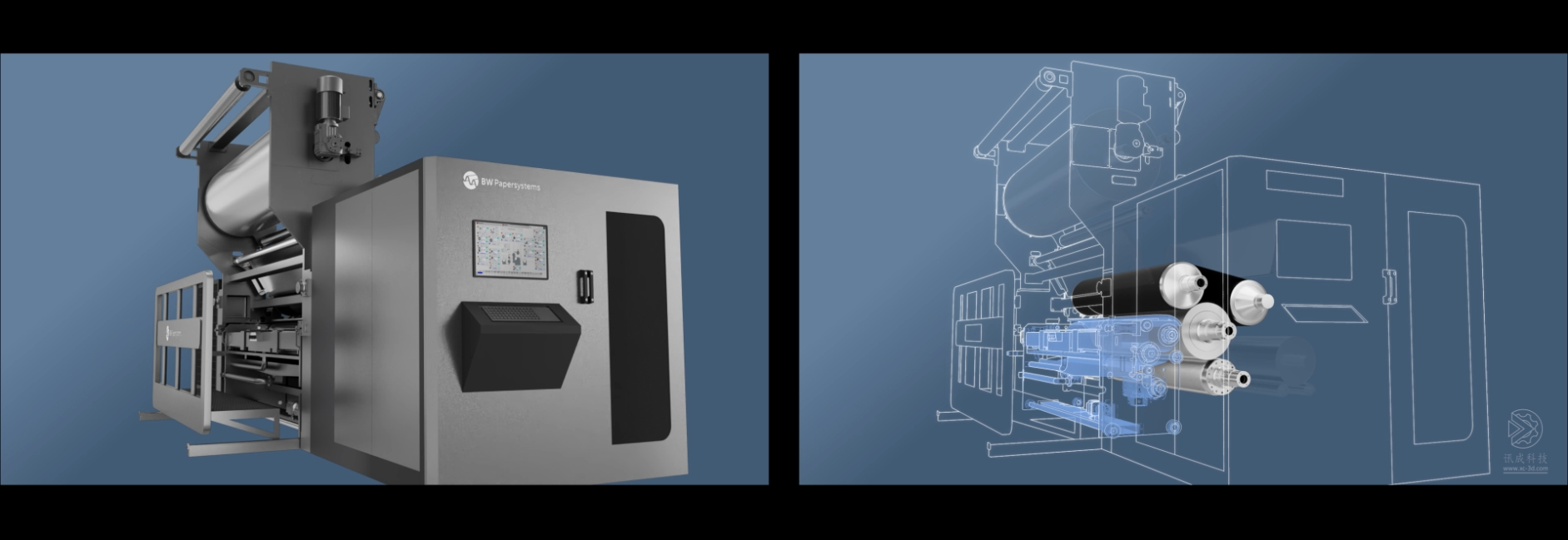
Let's look at the comparison shots below:

The shot on the right reveals the perspective of the core components of the equipment during the camera pan, informing the audience of their location and infusing the entire frame with a sense of technology. This is a display effect that live-action shots cannot achieve and is the charm of 3D animation. However, such a shot takes 4-5 times longer to produce than the one on the left.
3. Review and Revision: 7-10 days
This time frame does not include the time for Party A to provide revision feedback; it specifically refers to the production time taken by the animation company based on the revision requests from Party A.
III. Production Cycle Evaluation
In summary, the production cycle of industrial 3D animation is influenced by numerous factors. Evaluating under optimal conditions, the animation production cycle is roughly as follows:
1. Simple equipment (e.g., working principle of a car engine): 10-15 days.
2. Medium-sized equipment (e.g., working principle of a car powertrain): 20-30 days.
3. Large-scale equipment (e.g., working principles of car powertrain, chassis, body, electrical systems): 30-60 days.
4. Complex scenes (e.g., how the four major systems of a car coordinate their work under different road conditions): 45-90 days.
The above is an assessment of the production cycle under optimal conditions. In actual production, the following factors have a very significant impact on the production cycle:
1. Whether Party A can provide complete 3D models.
2. Whether Party A promptly answers questions raised by the animation company during the production process.
3. Whether Party A has unified opinions internally regarding the content and visuals intended for the animation.
4. Whether Party A provides timely feedback on revisions for the videos submitted by the animation company.
Understanding the above, equipment manufacturers should allocate buffer time when producing animations, prepare relevant materials thoroughly when deciding to proceed, and maintain timely communication during the production process to complete the animation as quickly as possible.
IV. Animation Production Cycle Optimization Techniques
Undoubtedly, obtaining a high-quality 3D animation quickly is crucial for Party A to expand its market and drive product sales. So, what are the optimization techniques for the animation production cycle?
1. Establish an efficient communication mechanism: Both Party A and Party B hold regular brief meetings to confirm progress and discuss animation production bottlenecks.
2. Pre-visualization (Pre-viz): The animation company can use this method to quickly submit a preview video, facilitating early communication and shot confirmation between both parties.
3. Phased delivery: Some animations can be completed by first finishing core shots (e.g., equipment operation sequences), advancing secondary scenes concurrently, and delivering in phases.
The essence of industrial 3D animation cycle management is the balance between “technical complexity + collaboration efficiency”, and thorough upfront cooperation between Party A and the production team ensures the final results better than simply compressing production time.
Featured FAQs:
Q: What are the application areas of industrial animation?
A: Industrial animation is widely used in machinery and equipment, energy and transportation, home appliances, building security, bridges and tunnels, and aspects of after-sales services such as product operation, usage, and maintenance.
Industrial animation application scenarios include: exhibition demonstrations, product sales, new plant planning, after-sales services, project bidding, achievement reporting, education and training, advertising and marketing, equipment maintenance, etc.
Q: How long is the animation video production cycle?
A: The production cycle of animation videos is greatly influenced by various factors:
1- Timeliness and completeness of materials provided by Party A.
Materials Party A needs to provide include: product or equipment 3D models, video script, company LOGO, and company information.
2- Complexity of the scenes and equipment to be animated. For example, animating the internal structure of a car driving on a tree-lined avenue is much more complex than statically displaying a bicycle.
3- Timeliness and effectiveness of communication between both parties during the production process.
Under normal circumstances, a standard 3D animation video production requires 15-20 days. For more complex models or larger scenes, it may take 30-60 days, or even longer.
Q: When is it suitable for a company to produce 3D animation?
A: The following three time points are relatively suitable for producing promotional 3D animations:
1- Before trade shows. It's best to have the animation video ready 15-30 days in advance to warm up for the exhibition;
2- When new products and new equipment are about to be launched into the market;
3- During significant client visits and exchanges.
4- During the product R&D phase: To assist inter-departmental communication and collaboration within the company; to help attract investment or partnership opportunities; to simulate design issues in advance, reducing R&D costs and risks;
5- During internal training phases.
It should be noted that 3D animation videos have a certain production cycle, and it is best to communicate with the production company in advance to arrange the production time reasonably.
About Xuncheng Technology
Founded in 2016, with 9 years of professional industrial 3D animation creation experience, our clients span various types of enterprises including startups, overseas clients, listed companies, and foreign-invested enterprises. We specialize in providing 3D animation creation services for mechanical equipment, high-tech industries, software development, and foreign trade companies. We offer one-stop industrial 3D animation creative services from product sales to after-sales maintenance.
We have provided nearly 3000 minutes of professional animation videos for over 200 manufacturing enterprises.
Whether at exhibition sites or during client visits; whether expanding into overseas markets or enhancing after-sales services, we firmly believe that through the power of design, complex products and machinery can be presented in astonishing 3D animations. This not only brings a unique visual experience to clients but also quickly resonates with them.